May 24, 2025 | In Big Ideas Post, Knowledge Hub, Op-Ed, Program & Events, Updates
In an era defined by constant activity and external pressure, the ability to pause has become increasingly rare.
Yet, that ability may be one of the most critical requirements for effective leadership.
Across societies, mental well-being is often discussed in clinical terms as stress, anxiety, burnout. While these are important, they only tell part of the story. Mental well-being is also shaped by culture, environment, and daily habits. It is influenced by how individuals process information, respond to pressure, and make decisions.
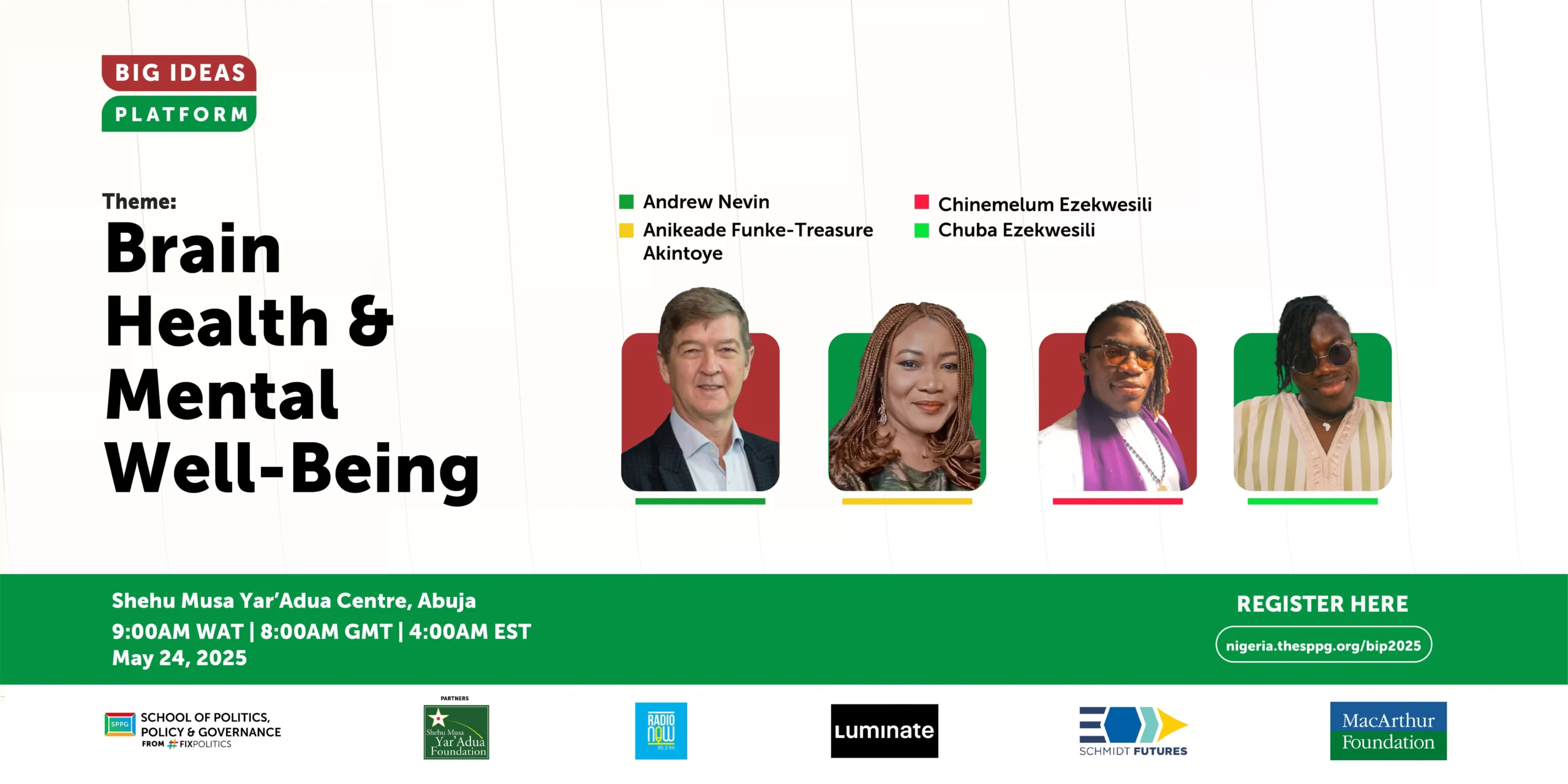
At the Big Ideas Platform 2025, Chuba and Chinemelum Ezekwesili explore this dimension through the lens of intentional living and inner leadership.
Their perspective challenges a common assumption: that external solutions alone can address internal strain. Instead, they argue that sustainable well-being begins with personal discipline, how individuals manage attention, energy, and response to their environment.
Modern life encourages constant engagement, continuous work, endless information, and little time for reflection. This creates a state of chronic reactivity, where decisions are driven by urgency rather than clarity.
The consequence is not only individual burnout, but weakened leadership capacity.
Effective leadership requires more than expertise or authority. It requires the ability to think clearly under pressure, to make considered decisions, and to maintain focus in complex environments. These capabilities are directly linked to mental well-being.
The framework proposed, slowing down, cultivating gratitude, and taking responsibility may appear simple, but it addresses a deeper issue: the need to stabilize the mind before attempting to influence systems.
This is particularly relevant in governance and public leadership, where decisions have wide-reaching consequences. A reactive mind cannot produce strategic outcomes.
Reframing mental well-being as a leadership discipline shifts the conversation. It positions inner stability not as a personal luxury, but as a professional necessity.
As societies confront increasingly complex challenges, the quality of leadership will depend not only on knowledge and policy, but on the mental clarity and resilience of those making decisions.
In that sense, mental well-being is not separate from leadership.
It is the foundation of it.
Menstrual health is not a peripheral issue. It is central to education, productivity, and mental well-being and by extension, to national development.