SPLN Research, Data, and Political Intelligence
A DIVE INTO THE INDEPENDENT NATIONAL ELECTORAL COMMISSION(INEC) VOTER REGISTER; 2015-2023
Introduction:
Every election cycle in Nigeria is marked by continuous voters’ registration which is at the heart of democratic elections. The exercise is exclusively handled by the electoral commission, INEC. Over the years, because of many unresolved challenges that can be summarized as the absence of the dividends of democracy, the Nigerian populace have shown as increasing disinterest in the electoral process and more so an increasing distrust in the electoral body. The voters registration head of the 2027 elections was just concluded but a question stand to be answered given the public call that usually follow the announcement of the continuous voter’s registration (CVR) exercise—the call for people to go out and register. The question is whether or not there is a relationship between the continuous voter’s registration and the election outcomes or it is just an exercise that issues another national identity card to the people. And if a relationship exists between CVR and election outcome, what is the nature of that relationship?
This article takes a dive into the voter’s register of the independent electoral commission for the 2015, 2019, and 2023 elections to find answers to the aforementioned questions. The years here mentioned are selected because of data availability and the context of the referenced elections, the electoral act and the introduction of card readers.
Data and Analysis
A summary of the voter’s register for the years in focus are presented in table 1. A very important pattern in the data presented in table 1is the increasing number of registered voters which points to the effectiveness of the campaigns calling for the public to go and get registered. However, a negative pattern emerges for voter’s turnout during election. Total number of votes cast (as collated) decreased from 29.432m in 2015 to 28.614m in 2019 and 24.965m in 2023 which is only 35.66% in 2019 and 27.05% in 2023. This points to the increasing disinterest of the public in the democratic process for a number of reasons that are beyond the scope of this article. A question arises as to whether or not the election outcomes would have been different if just 50% of the voters turned out to vote for the candidates of their choice.
In 2015, Mohammandu Buhari won the presidential election with 15,424,921 votes (53.96%) while the first runner up, Goodluck Jonathan had 12,853,162 votes (44.96%). In 2019, President Buhari won the election with 15,191,978 votes (55.60%) and his runner up, Atiku Abubakar had 11,262,978 (41.22%) votes and in 2023 where the votes were shared between three major candidates, Bola Ahmed Tinubu won the election with 8,794,726 (36.61%) votes, the first runner up, Atiku Abubakar had 6,984,520 (29.07%) votes, and Peter Obi followed with 6,101,533 (25.40%) votes. Between 2015 and 2019, there isn’t much difference between the votes with which Muhammadu Buhari won and in 2023 where there were three major candidates, if the was just two major candidates as the previous years, the winner would have won the election with just about 12 million votes. While the data here presented is limited, it is safe to assume given the pattern that to win a presidential election in Nigeria, one need 12-15million votes which is not particularly dependent on the increasing number of voters.
Table 1: Summary of Voter’s Register and Votes at the end of elections (Source: INEC)
| 2015 | 2019 | 2023 | ||
| 1 | Total number of registered voters | 67,422,005 | 84,004,084 | 93,469,008 |
| 2 | Total number of registered voters (as collated) | 82,344,107 | ||
| 3 | Total number of accredited voters (as collated) | 31,746,490 | 29,364,209 | 25,286,616 |
| 4 | Total number of valid votes (as collated) | 28,587,564 | 27,324,583 | 24,025,940 |
| 5 | Total number of rejected votes (as collated) | 844,519 | 1,289,607 | 939,278 |
| Total number of votes cast (as collated) | 29,432,082 | 28,614,190 | 24,965,218 | |
| Percentage turn out (as collated) | 35.66% | 27.05% |
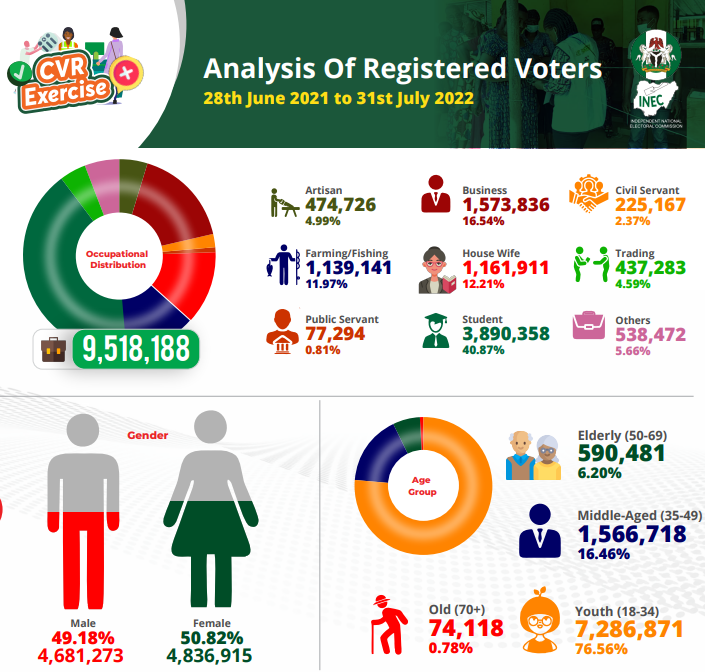
Figure 1 presents an analysis of the voter’s registration exercise of 2022 in the lead up to the 2023 election. From the data, there were over 9.5m news voters, 40.87% of which are students making up the largest group followed by business owners at 16.54% then farmers making up just about 11.97% of the new voters. Demographically, young people (18-34) make up 76.56% of the new voters for the 2023 election. However, as previously mentioned, this increase does not reflect in the election outcomes. Table 2 presents the occupational spread of accredited voters in the 2015 elections.
 Fig. 1 Analysis of Registered Voters 2022 (Source: INEC)
Table 2: Occupation Spread of 2015 Accredited voters (Source: NEC)
| Occupation | Total | % Accredited |
| Artisan | 1,047,660 | 4 |
| Business | 3,036,291 | 13 |
| Civil servant | 1,671,190 | 7 |
| Farming/fishing | 5,054,695 | 21 |
| Housewife | 4,137,769 | 18 |
| Other | 1,421,768 | 6 |
| Public servant | 533,691 | 2 |
| Student | 4,679,481 | 20 |
| Trading | 2,060,934 | 9 |
| Total | 23,643,479 | 100 |
The voters’ data presented in table 2 for the 2015 elections shows expectedly that students and farmers make up for close to 50% of the voters of which publicly available data corresponding to the demographic distribution of the country shows that at least 60% of voters in recent elections are young people age 18 to 34 who also make up the largest demography of people that do not turn out for elections. Unsurprisingly, the young demographic is the most important demographic that directly determine the outcomes of elections in the country either by showing up to vote or not showing up.
Implication
The analysis suggests that electoral success in Nigeria is less dependent on expanding the voter register and more dependent on efficiently mobilizing a consistent subset of voters. Given that turnout has remained within a relatively narrow band, political actors may achieve greater strategic advantage by focusing on voter activation, turnout optimization, and targeted engagement of reliable voting blocs. In practical terms, this means that the path to electoral victory lies not in increasing the size of the electorate, but in maximizing participation within an already constrained active voter base. This has significant implications for campaign strategy, resource allocation, and voter engagement models heading into future elections.
Highlights
- Elections will not be won by expanding the voter base — they will be won by controlling turnout. Mass registration drives are politically useful for optics, but strategically inefficient unless they convert to turnout
- Where votes come from matters more than how many exist. The young demography is the keystone demography that swings the elections, especially the students, farmers, and business owners who contribute at least 50% of the votes.
Some assumptions
- The election in February is a contribution factor to the poor turn out of young people (students). The strike of 2022/23 plays an important role in the heighten participation of the young people in campaigns even though that participation did not translate to high turn out during election.
- Insecurity is a major driver of poor voters turn out

The Purpose and Price of Disruptive Change
The Purpose and Price of Disruptive Change
Chukwuma Charles Soludo, CFR
Being the First Graduation Day Keynote Speech at the SPPG Pioneer Class of 2021 (International Conference Centre, Abuja): January 29, 2022
0: PROTOCOL
Dear Friends, let me begin by appreciating one of Africa’s finest amazons and founder of the School of Politics, Policy and Governance (SPPG), my sister Dr. Mrs Obiageli Ezekwesili (Oby) for continuing to be a key change maker in Africa. Graduating the first class of the SPPG today is like planting many seeds in a wide field: some may end up as iroko trees, others as shrubs, but we hope that together, they will all bond into a visible and impactful forest. When I received Oby’s letter some five days ago, I concluded that given my punishing schedule at the moment, I would just come and make a few extempore remarks. But I decided last night to scribble a few talking points— to avoid being misquoted. Therefore, if I appear incoherent, please forgive me.
The Graduation Theme is “Emergence of Unconventionals”. I understand that SPPG was founded to radically and deliberately transform the quality of political and public leadership in Nigeria and Africa, with a view to building a pipeline of value-based and disruptive thinking political class equipped with requisite knowledge and skills to solve complex problems of development in order to reposition Africa in the 21st Century. This is music to my ears and Africa is grateful to Oby.
In 1999, I co-authored a book entitled “Our Continent, Our Future: African Perspectives on Structural Adjustment”. In 2000, I was the long-term consultant in a pan African project that resulted in a book published by the World Bank entitled “Can Africa Claim the 21st Century?” In both books, we identified the centrality of disruptive leadership and a developmental state in Africa’s renaissance. A little over 20 years later, the SPPG has set out to walk the talk by working to deliberately orchestrate the emergence of leaders with knowledge and capabilities.
You can therefore understand why I am personally elated to be speaking at the first graduation ceremony of this cohort of emerging unconventional leaders. Congratulations to you all, and in a few seconds, I will be commiserating with you as well. You volunteered to be in this team, and my charge to you is to go out and make the difference: be the change you have offered to see. Africa is waiting for you. Africa is watching you. Do not let us down.
On leadership, Africa has had a chequered history. While some see only the dark spots, I actually see multi colours of the good, the bad and the ugly. While the bad and the ugly dominate, I always try to avoid what our other sister, Chimamanda Adichie called the “single story” of the African narrative. In some ways, part of our future is in our past. When I read about the plans, values, passion, and accomplishments of some of Africa’s liberation/independence leaders such as Julius Nyerere, Kwame Nkrumah, Nelson Mandela, Patrice Lumumba, Nnamdi Azikiwe, etc I have cause to smile as an African. Back home, I am inspired by the examples of Aminu Kano, M.I. Okpara, Obafemi Awolowo, Sir Ahmadu Bello, etc in our first republic. We can fill up hundreds of pages as eulogy to our gallant and patriotic past heroes and heroines, including those distinguished civil servants, captains of industry, journalists, civil society activists, musicians, etc who worked hard and some even paid the ultimate price to see Nigeria a better place. In our more recent history, especially since 1999, we have seen occasional glitters of hope here and there but despair deepens. Around the continent, there is a mixture of bright and gloomy stories. “Africa Rising” was not just a fluke. The Dark Continent remains potentially the land of opportunities and could indeed be the global economic driver of the 22nd century. But the time to lay the foundation is now. The second scramble for Africa is raging, with the Chinese on the loose. Africa indeed needs new orchestra teams and new songs. It needs to run at the speed of a thousand kilometres an hour to seize back its future and shape its narrative. The graduates of SPPG have onerous and daunting tasks ahead of them. You have my commiserations!
With some 140 multidisciplinary topics covered in the past eight months, what can anyone tell you again in terms of knowledge. You have it, and also know where to find more if needed. With the hoes and machetes, the next is to get into the farm and ensure higher productivity. That farm is the field of politics, policy and governance. I am sure you carefully studied the nature of that farm in Nigeria and Africa, and I wish you good luck as you try to navigate through it to leave the society better than you met it.
But let me suggest, for emphasis, that indeed Africa needs a new liberation movement. The first struggle was liberation from the colonial masters. The second will be liberation from rentier politics and politicians. For me, there is almost a sense of nostalgia, recalling the mission and accomplishments of our founding fathers, especially as we contemplate the world without oil in Nigeria. Much of the existing social order is founded on competition for, and distribution of, rents. Oil and the easy money that came with it destroyed the social fabric and the elite created new institutions and political structures to maximize their gains. As the noose tightened globally on other rentier/criminal enterprises such as drug trafficking or internet scamming, many of the barons flocked into politics as the next easy alternative.
Politics has become big business. Appointment or election into public office is seen largely as an opportunity to “eat” rather than a call to selfless service. There is an army of rich (big men) who have never worked or done any productive work in their life and believe that it is their right to expect something for nothing. The tiny less than one percent elite have a stranglehold on the public purse, sprinkling occasional crumbs to the citizens as ‘dividends of democracy’. The citizens themselves either out of helplessness or acquiescence join the party, expecting the politicians to dole out pittance out of public treasury as charity. The citizens actually clap for such phantom “charity”. Politicians who refuse to do so are deemed as “stingy” or “wicked”, and the circus goes on. With a rentier system, a culture of freebies emerged, and most people don’t expect to pay for anything, including taxes, electricity, water, petrol, etc. A classic feature of the political environment is that corruption has become part of the “culture”, with little incentive for honesty. Honesty is scorned as wickedness, foolishness or mere pretense, and those who dare to be different have a steep price to pay. So, who among you is ready to be honest and scorned by society?
Oil is on its way out, but dismantling the decades-old debilitating institutions and politics around it won’t be a tea party. Nigeria is now at a fiscal cliff with a crunching solvency challenge. Youth unemployment, insecurity, poverty, inflation, etc threaten the social fabric. Migrating to a post oil world of 4th Industrial revolution and sustainable prosperity will require massive disruptive transformations and restoration of a productive social contract.
Such disruptions will come at great costs, and could indeed be dangerous. It is not far to imagine what could befall serious disruptors. In Nigeria, we remember what happened to Murtala Muhammed, and the history books are replete with hundreds of examples of the inherent risks. At a personal level, undertaking the banking revolution in Nigeria came with 19 written threats to me and my family, including physical attacks. Disrupting the existing social order is dangerous. Beneficiaries of the current order are powerful enough to organize and viciously fight back to protect their privileges. On the contrary, the masses who are the ultimate beneficiaries are not organized enough to act as a bulwark against the special interests. As things stand currently, we are standing between the rock and the hard place. With the objective to retain power within the context of short electoral cycles, politicians are afraid to undertake the necessary disruptive changes to guarantee long term safety and prosperity for all. On the other hand, the existing trends are totally unsustainable and the system is living on borrowed times. Everyone is sleepwalking to the hard place, and praying that somehow a miracle will happen along the way.
So, who is ready to put his head on the line to lead such productive but dangerous disruptions? Are the SPPG graduates ready for the assignment? I assume that you can’t wait to get to work, to apply your knowledge for a new Nigeria. Am I right? You have my prayers! As I pray for your success, let me throw up a few random nuggets to chew on your way.
Dear friends, fixing politics requires talent and skills. But these won’t be enough. It won’t happen by lone wolves working in silos. It requires new developmental organizations – organizations/teams of believers, driven by defined ideology, purpose and character. Let’s be clear about one point: Nigeria does not lack well educated/skilled and widely travelled stock of human capital to drive her development. In the U.S alone, Nigeria ranks highest on education among ethnic minorities and as a percentage of its population, it has the most educated population of all ethnic groups. At home, we have over 100 universities churning out hundreds of graduates every year. All over the world, Nigerians excel as champions in their various fields. A key missing link is purpose driven cohesion and organization for transformation of the homeland. There are many disparate groups and organizations, including political parties which claim (at least on their statutes) to champion national development. Only a few, if any, can be identified by any soul in terms of a nationalist ideology, professed and practiced by its members. The liberation struggle for independent Africa was driven by a nationalist ideology to be anchored by a developmental state. There is a huge void today, and I am not sure how we can fix our politics without the requisite organizations for change.
So, my first charge to my new friends and graduates is to profess their purpose in the political farmland and actively participate to actualize it. If you have not yet done so, when you go home today, write down your purpose (what do you want to achieve) in the public arena and paste same beside your reading table or anywhere for everyday reference. Then join a political party, a civil society organization, or organize alternative better platforms of leverage. You may better disrupt from inside than outside. Organization is power. The key is to participate in the process or stop complaining. For Nigeria, most people focus on politics in Abuja and we have for too long tried in vain to fix Nigeria from the obtuse centre. It is time to try fixing it and its politics from below— from the subnational units. If you have something to offer, go and run for office. Win or lose, your participation will add something to the process. Then persevere, endure, and remain focused on delivering your purpose.
For starters, let me suggest that the Alumni of SPPG should form themselves into a New Nigeria Network for change. As SPPG expands, an African network would emerge. Over the next decade, I can see a network of thousands of Africans who share a common template for redeeming our heritage. A Pan African movement may eventually take the stage by storm. The SPPG graduates must literally inculcate and profess a messianic philosophy as the driving force behind their network. It is good to look up to a role model for continuous inspiration or let each SPPG member carry the badge of honour and integrity everywhere. Personally, I would like to hear graduates of SPPG keep reminding the society that “as a graduate of SPPG, there are things I can’t do”, or “as a graduate of SPPG, I always stand up for public interest and not for personal gains” or “I am prepared to pay any price or go to any length to make Africa great”. Just do something different; say something different.
As part of your participation, please deliberately mainstream volunteerism. Don’t waste your new skills or wait until you are in public office. Find or create opportunities to deploy them. Volunteer to teach one hour a week in a local school. You can never imagine the impact. Volunteer in community service: providing information and helping with environmental management, traffic control, public education on lifestyle changes, mentor children and youths, etc. Indeed, volunteer to serve in the village government or clan. Barack Obama failed his first election and went to offer community services, and from there attempted again, and again. Fixing politics requires illustrative personal examples. As Mother Teresa advised, if you can’t change a million lives, start with one. Won’t it be great and a new dawn if on daily basis, each member of the SPPG alumni posts what actions he/she took to be the change he/she desires? Imagine spin-off organizations around Africa with millions of members over time on the same vision and mission. Obviously, something will give!
Dear friends, I won’t end these remarks without reiterating the centrality of purpose in the bid to fix politics. Purpose is everything. If you have not read it, I sincerely recommend the book entitled “The Purpose Driven Life: What on Earth Am I Here For” by Rick Warren. Purpose is deeply personal. Everyone must have that personal deep reflection and answer that question: “what on earth am I here for”? For some, the answer is roundly selfish: to eat, drink, marry, build house(s), and accumulate and accumulate all the vanities of the world and then die. In the circumstance, political arena is nothing but a dining table. I know many people trained in some of the best universities in the world and widely travelled but who complain about being deployed to ministries considered “dry” in public service in comparison to the ones they considered as “juicy”. In this instance, it is not about knowledge and skills but purpose. For others, there must be a divine purpose why God in His infinite wisdom decided to make you an African, a Nigerian, etc. If the divine purpose is interpreted to mean that God sent you here to contribute in leaving His creation better than you met it, then you must be driven by a different meaning and impetus to life.
Every society that has prospered and endured has been led by men and women who have discovered a higher purpose beyond self. For such people, politics is a vocation for selfless service and not a job. Such people are driven by a single purpose— to make a difference and leave legacies. Whenever and wherever competence is augmented with character and developmental ideology, the society wins. I recently re-read Lee Kuan Yew’s book “From Third World to First”, and can’t stop being inspired. The combination of competence and driven by higher purpose produced such a transformational leadership that orchestrated a miracle in development. In one of his last speeches before death, Lee Kuan Yew observed that he and his colleagues were prepared that even if they died trying to make Singapore great, they would have been happy to die for a worthy cause. The choice is personal. The choice is yours.
But if perchance, you choose, as I believe you have elected, to join the crusade for a better Africa, and knowing the missiles that will come your way as you strive to do good and be different, let me encourage you with the great words by President Theodore Roosevelt in 1910: “It is not the critic who counts; not the man who points out how the strong man stumbles, or where the doer of deeds could have done them better. The credit belongs to the man who is actually in the arena, whose face is marred by dust and sweat and blood; who strives valiantly; who errs, who comes short again and again, because there is no effort without error and shortcoming; but who does actually strive to do the deeds; who knows great enthusiasms, the great devotions; who spends himself in a worthy cause; who at the best knows in the end the triumph of high achievement, and who at the worst, if he fails, at least fails while daring greatly, so that his place shall never be with those cold and timid souls who neither know victory nor defeat”.
Dear friends, let me end with this simple prayer for you. May God of Africa grant you the wisdom to discover the divine purpose for your life, the wisdom to know what is right, and very importantly, the courage to do it.
God bless you!
God bless Nigeria!!
Prof. Charles Chukwuma Soludo