
A DIVE INTO THE INDEPENDENT NATIONAL ELECTORAL COMMISSION(INEC) VOTER REGISTER; 2015-2023
Introduction:
Every election cycle in Nigeria is marked by continuous voters’ registration which is at the heart of democratic elections. The exercise is exclusively handled by the electoral commission, INEC. Over the years, because of many unresolved challenges that can be summarized as the absence of the dividends of democracy, the Nigerian populace have shown as increasing disinterest in the electoral process and more so an increasing distrust in the electoral body. The voters registration head of the 2027 elections was just concluded but a question stand to be answered given the public call that usually follow the announcement of the continuous voter’s registration (CVR) exercise—the call for people to go out and register. The question is whether or not there is a relationship between the continuous voter’s registration and the election outcomes or it is just an exercise that issues another national identity card to the people. And if a relationship exists between CVR and election outcome, what is the nature of that relationship?
This article takes a dive into the voter’s register of the independent electoral commission for the 2015, 2019, and 2023 elections to find answers to the aforementioned questions. The years here mentioned are selected because of data availability and the context of the referenced elections, the electoral act and the introduction of card readers.
Data and Analysis
A summary of the voter’s register for the years in focus are presented in table 1. A very important pattern in the data presented in table 1is the increasing number of registered voters which points to the effectiveness of the campaigns calling for the public to go and get registered. However, a negative pattern emerges for voter’s turnout during election. Total number of votes cast (as collated) decreased from 29.432m in 2015 to 28.614m in 2019 and 24.965m in 2023 which is only 35.66% in 2019 and 27.05% in 2023. This points to the increasing disinterest of the public in the democratic process for a number of reasons that are beyond the scope of this article. A question arises as to whether or not the election outcomes would have been different if just 50% of the voters turned out to vote for the candidates of their choice.
In 2015, Mohammandu Buhari won the presidential election with 15,424,921 votes (53.96%) while the first runner up, Goodluck Jonathan had 12,853,162 votes (44.96%). In 2019, President Buhari won the election with 15,191,978 votes (55.60%) and his runner up, Atiku Abubakar had 11,262,978 (41.22%) votes and in 2023 where the votes were shared between three major candidates, Bola Ahmed Tinubu won the election with 8,794,726 (36.61%) votes, the first runner up, Atiku Abubakar had 6,984,520 (29.07%) votes, and Peter Obi followed with 6,101,533 (25.40%) votes. Between 2015 and 2019, there isn’t much difference between the votes with which Muhammadu Buhari won and in 2023 where there were three major candidates, if the was just two major candidates as the previous years, the winner would have won the election with just about 12 million votes. While the data here presented is limited, it is safe to assume given the pattern that to win a presidential election in Nigeria, one need 12-15million votes which is not particularly dependent on the increasing number of voters.
Table 1: Summary of Voter’s Register and Votes at the end of elections (Source: INEC)
| 2015 | 2019 | 2023 | ||
| 1 | Total number of registered voters | 67,422,005 | 84,004,084 | 93,469,008 |
| 2 | Total number of registered voters (as collated) | 82,344,107 | ||
| 3 | Total number of accredited voters (as collated) | 31,746,490 | 29,364,209 | 25,286,616 |
| 4 | Total number of valid votes (as collated) | 28,587,564 | 27,324,583 | 24,025,940 |
| 5 | Total number of rejected votes (as collated) | 844,519 | 1,289,607 | 939,278 |
| Total number of votes cast (as collated) | 29,432,082 | 28,614,190 | 24,965,218 | |
| Percentage turn out (as collated) | 35.66% | 27.05% |
Figure 1 presents an analysis of the voter’s registration exercise of 2022 in the lead up to the 2023 election. From the data, there were over 9.5m news voters, 40.87% of which are students making up the largest group followed by business owners at 16.54% then farmers making up just about 11.97% of the new voters. Demographically, young people (18-34) make up 76.56% of the new voters for the 2023 election. However, as previously mentioned, this increase does not reflect in the election outcomes. Table 2 presents the occupational spread of accredited voters in the 2015 elections.
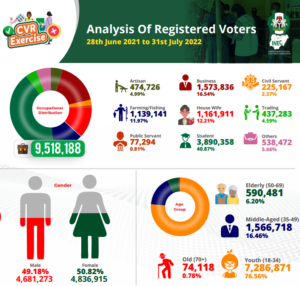 Fig. 1 Analysis of Registered Voters 2022 (Source: INEC)
Table 2: Occupation Spread of 2015 Accredited voters (Source: NEC)
| Occupation | Total | % Accredited |
| Artisan | 1,047,660 | 4 |
| Business | 3,036,291 | 13 |
| Civil servant | 1,671,190 | 7 |
| Farming/fishing | 5,054,695 | 21 |
| Housewife | 4,137,769 | 18 |
| Other | 1,421,768 | 6 |
| Public servant | 533,691 | 2 |
| Student | 4,679,481 | 20 |
| Trading | 2,060,934 | 9 |
| Total | 23,643,479 | 100 |
The voters’ data presented in table 2 for the 2015 elections shows expectedly that students and farmers make up for close to 50% of the voters of which publicly available data corresponding to the demographic distribution of the country shows that at least 60% of voters in recent elections are young people age 18 to 34 who also make up the largest demography of people that do not turn out for elections. Unsurprisingly, the young demographic is the most important demographic that directly determine the outcomes of elections in the country either by showing up to vote or not showing up.
Implication
The analysis suggests that electoral success in Nigeria is less dependent on expanding the voter register and more dependent on efficiently mobilizing a consistent subset of voters. Given that turnout has remained within a relatively narrow band, political actors may achieve greater strategic advantage by focusing on voter activation, turnout optimization, and targeted engagement of reliable voting blocs. In practical terms, this means that the path to electoral victory lies not in increasing the size of the electorate, but in maximizing participation within an already constrained active voter base. This has significant implications for campaign strategy, resource allocation, and voter engagement models heading into future elections.
Highlights
- Elections will not be won by expanding the voter base — they will be won by controlling turnout. Mass registration drives are politically useful for optics, but strategically inefficient unless they convert to turnout
- Where votes come from matters more than how many exist. The young demography is the keystone demography that swings the elections, especially the students, farmers, and business owners who contribute at least 50% of the votes.
Some assumptions
- The election in February is a contribution factor to the poor turn out of young people (students). The strike of 2022/23 plays an important role in the heighten participation of the young people in campaigns even though that participation did not translate to high turn out during election.
- Insecurity is a major driver of poor voters turn out